Ramadan Family Pajamas Manufacturer: 2027 Eid Sourcing Guide for Middle East Buyers
Note on dates: Ramadan and Eid dates are projections. Final dates depend on the official local moon sighting. For 2027, Ramadan is projected to begin on 8 February, with Eid al-Fitr on 9–10 March.
For sleepwear and loungewear, Ramadan through Eid is the single biggest season of the year for family-matching sets in the Middle East. If you are sourcing Ramadan family pajamas for a retail or wholesale programme, the season’s biggest risk is not demand — it is the calendar. Chinese New Year falls on 6 February 2027, and factories in China typically shut down for 2–3 weeks. Once an order slips past that window, the lead time simply grows by those 2–3 weeks, and the holiday will not move to wait for production.
This guide covers the market logic, the products worth developing, fabric and colour planning, the order calendar, the risks to watch, and the checks to run before you place a bulk order.
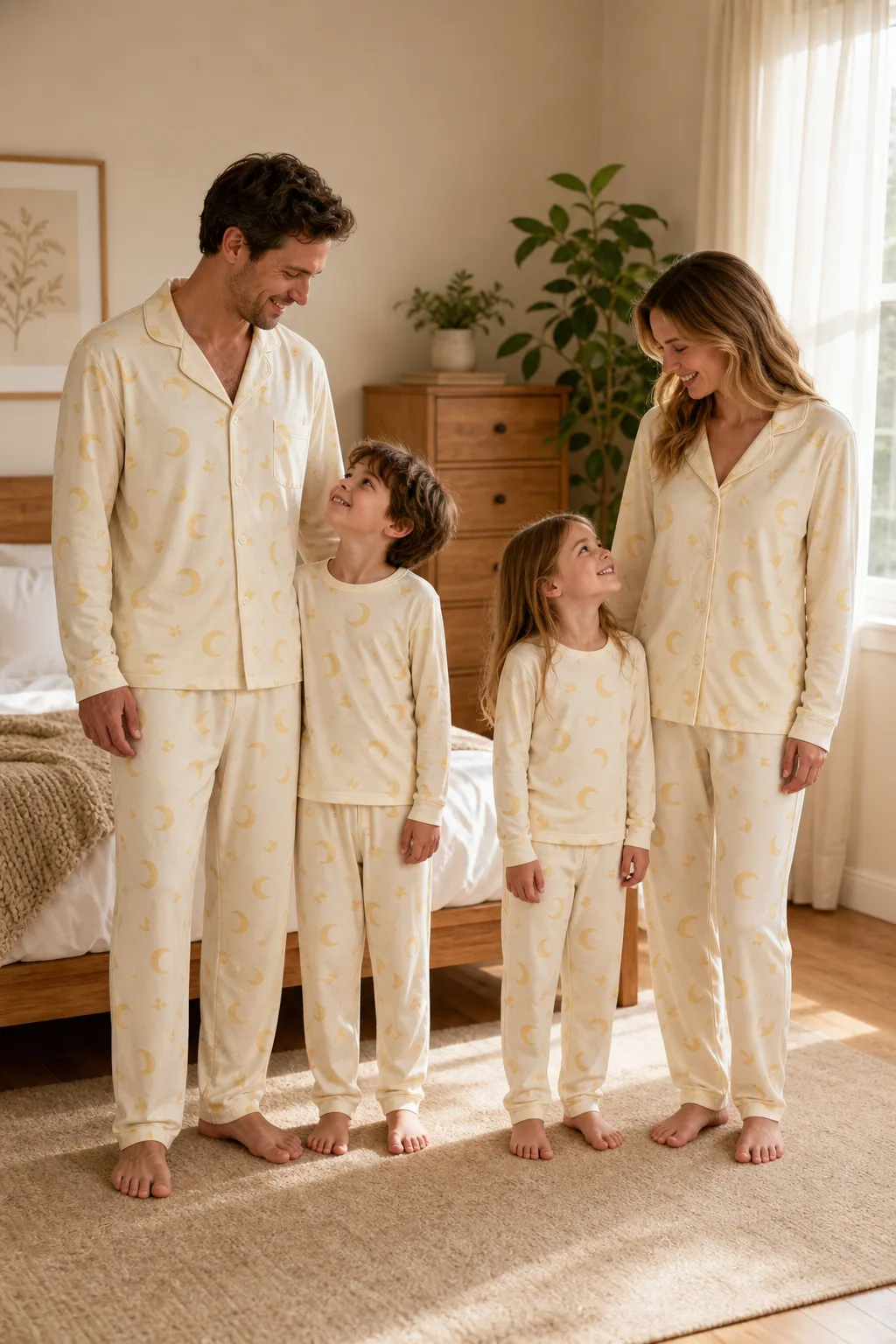
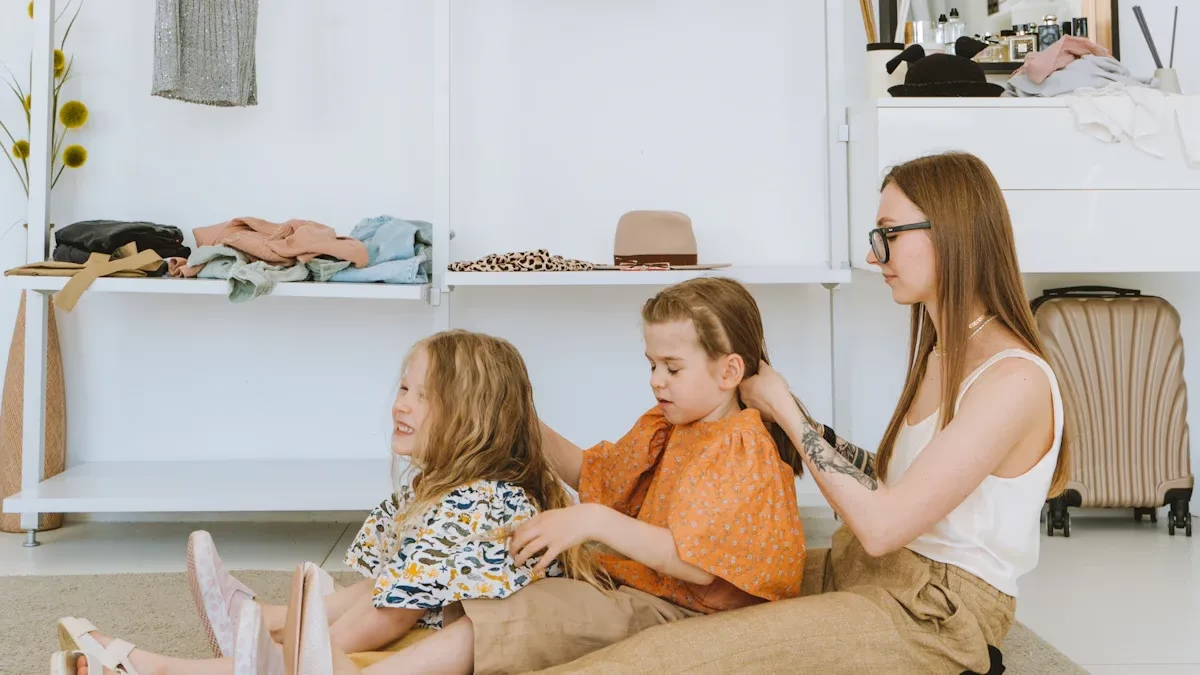
Figure 1 | Beige moon-and-star print family pajama set: adult and child versions in the same fabric, warm indoor setting.
Why Ramadan and Eid Drive a Surge in Sleepwear Demand
Demand for this category is not primarily driven by going-out clothing. It comes from a change in how households actually spend their time.
Ramadan resets the daily routine
With daytime fasting and gatherings and meals running late into the night, families spend far more hours at home, so the actual wear time of sleepwear and loungewear lengthens considerably. Unlike going-out apparel, this category’s sales track directly to time spent at home.
The Eid family photo is a tradition
Taking a family portrait on Eid day is extremely common, and it is what creates the family-matching set as a genuine must-buy sub-category rather than a novelty.
New clothes for the holiday
Buying new clothing for Eid is a local tradition, and every member of the household — including infants and toddlers — is budgeted for.
Strong gift dynamics
Holiday sets for newborns are usually bought by relatives and friends rather than by the parents themselves. That keeps price sensitivity relatively low in this segment, while raising the bar on packaging and the sense of occasion.
This market does not need to be educated. Middle East mother-and-baby channels already treat holiday sleepwear and newborn gifting as fixed categories, and major platforms run dedicated Ramadan sections and gift channels. Demand is a given. The main competitive question is whether you can deliver on time.
The Four Family-Matching Products Worth Developing
. Matching Family Pajama Sets
One fabric, one colour code, covering baby sizes through adult sizes — the irreplaceable core product for this season.
The main risk: baby pieces and adult pieces absolutely must come from the same dye lot. Shade variation between dye lots is nearly impossible to notice on a single person, but it is glaringly obvious in a family photograph, and it is the single largest source of negative reviews in this category.
2. Baby Eid Pajama Gift Sets
This is the most gift-driven product in the range. Name or birth-date embroidery can be added, and the set can ship with a hang tag and a gift box. Safety priorities: no small detachable parts, no excessively long cords or ties, and the neckline binding must be securely finished.
3. Sibling Sets (2–6 Children)
Same fabric and same trims, with only the sizes scaled. Development cost is low and reorders are fast, which makes this a strong entry product for a first Middle East holiday range.
4. Ramadan Loungewear
Loose long-sleeve, long-leg cuts with good coverage. Prints can draw on star-and-crescent, geometric and floral elements. Because Ramadan brings frequent family gatherings, this set works for both the home and for receiving guests — a broader range of use than pure sleepwear.
Fabric, Colour and Dye-Lot Consistency
Ramadan and Eid 2027 fall in February and March, when Gulf temperatures are lower than at the height of summer, so mid-weight fabrics are workable. But with more indoor gatherings and longer wear times, breathability is still the first criterion.
Avoid fabrics with a high polyester share. Polyester breathes poorly and clings when the wearer perspires, and in a category worn for long stretches, how the fabric feels on the body feeds straight into end-customer reviews.
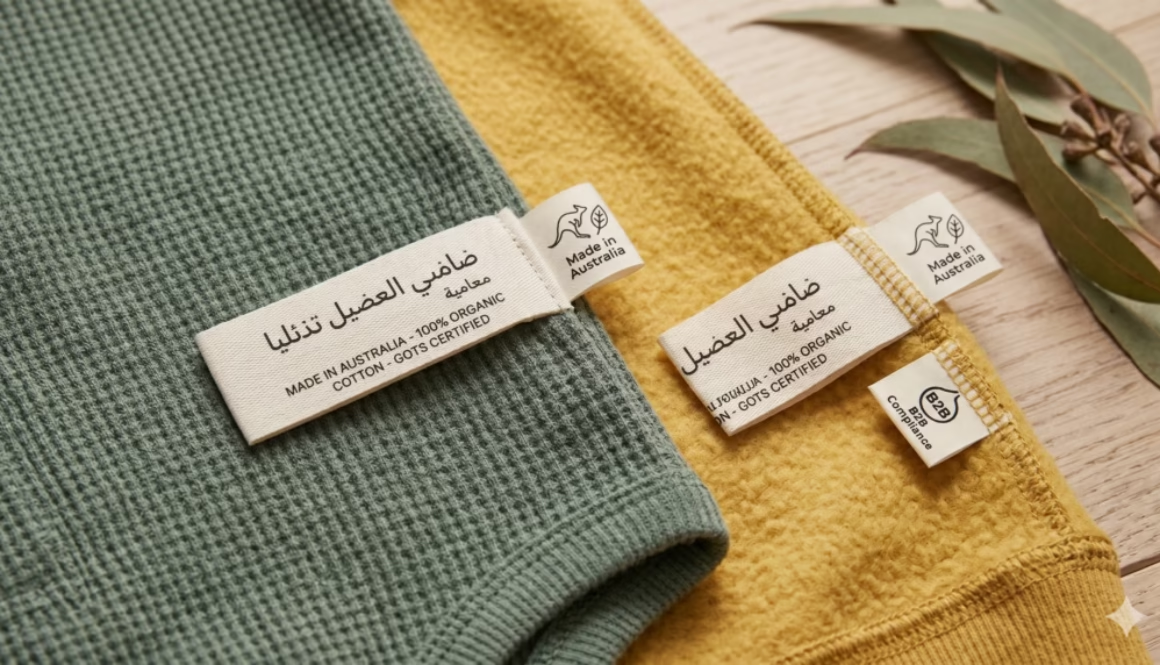
Recommended fabrics: pure cotton, bamboo fibre, modal, cotton-linen blends, قطن عضوي and waffle knit. Development from a customer-supplied fabric card is also possible.
Important: keep one set to one fabric wherever you can. Switching fabric changes both colour and hand-feel, which is exactly what breaks a family photo. Hold the constructions in a series to one or two types as well. At a distance in a group photo, consistent construction reads as a deliberate set; a different construction on every piece just looks like several garments thrown together.
Three-Tier Colour Plan
| الفئة | Colours | How to use |
|---|---|---|
| Core | Sand, camel, ivory, off-white | The backbone of family sets. Works from baby sizes through extended adult sizes, and makes it easier to keep one dye lot and control shade variation. |
| Seasonal | Sage green, olive, dusty pink, terracotta, deep navy, lavender | Separates sets and price bands from one another. Also suits sibling sets. |
| Accent | Gold thread, silver thread | Piping, woven labels and small embroidered areas only. Do not cover a whole garment. |
Order Scheduling: Plan Around the Chinese New Year Shutdown
How we define lead time: bulk production is 45–50 working days, meaning the full cycle from order confirmation through to the goods arriving at the buyer’s warehouse, including production, logistics and customs clearance. Sampling is 7–15 working days.
Counting back from a 1 February on-shelf date, one week before Ramadan begins:
| Your situation | Latest order deadline |
|---|---|
| Need full sampling and approval | Lock the order by early November 2026 |
| Already have an approved sample, going straight to bulk | Lock the order by late November 2026 |
| Starting a new project in December or later | Effectively cannot reach shelves before Ramadan |
The critical variable: Chinese New Year falls on 6 February 2027, with a 2–3 week factory shutdown. Place your order in early November and production runs from November through January, shipping before the holiday — the shutdown never touches you. Delay to December and the production window collides with the shutdown, adding those 2–3 weeks directly to your lead time. The holiday date will not move for your order.
Contingency: if you must hit the date, air freight is the lever. Sea freight runs roughly 29–33 days end to end, while air freight takes only 3–5 days, which closes a 2–3 week gap.
Also available: DDP door-to-door. Under a DDP quote, destination-country duties and customs clearance are included, so the buyer does not have to handle import clearance or hold import qualifications.
MOQ and Wholesale Pricing for Family Pajamas
The minimum order quantity (MOQ) is 200–300 pieces per style per colour, and it moves with the fabric and the complexity of the construction.
That floor exists for a physical reason: fabric knitting and dyeing carry their own minimums, and a style has to be cut, sewn and finished as one production run to stay consistent. Where your order lands in the 200–300 range depends mainly on which fabric you choose and how many processes the construction requires — a stock fabric with a standard colour card sits at the lower end, while a custom-developed fabric or a dedicated dye lot pushes toward the upper end.
Provided the fabric and construction stay the same, the piece count can be split flexibly across sizes. This matters enormously for family-matching sets: baby sizes and adult sizes have very different demand profiles, so an even split across sizes all too often leaves some sizes overstocked and others out of stock.
A quote covers: fabric and construction confirmation, colour and print sampling, pre-production sample approval, and pre-shipment AQL inspection with a photo and written report.
OEM and ODM customisation are both supported. Brand logo, hang tags, care labels and gift-box packaging can all be customised.
Eight Checks Before You Approve Bulk Production
Approve a supplier on paperwork, not on a sample. A sample proves what a factory can do once; these eight checks prove what it can repeat across a 200–300 piece run and across every reorder after it.
- Fabric composition and measured weight (GSM). Ask for the actual test data, not the nominal spec.
- A complete size chart with tolerances, covering baby sizes through extended adult sizes.
- Approved colour swatches or print samples signed off before production starts.
- Garment wash testing: colour fastness and shrinkage rate.
- Rubbing colour fastness on dark fabrics and metallic embroidery thread. These are the most common failure points in the range.
- Pull testing on children’s components: beads, sequins, appliqués and similar attachments.
- The pre-shipment AQL inspection report.
- Compliance certification for your destination market: GOTS for organic cotton and OEKO-TEX Standard 100; CPSIA / CPC preparation for the United States; and EN 14682 cord and drawstring safety for children’s apparel in the European Union.
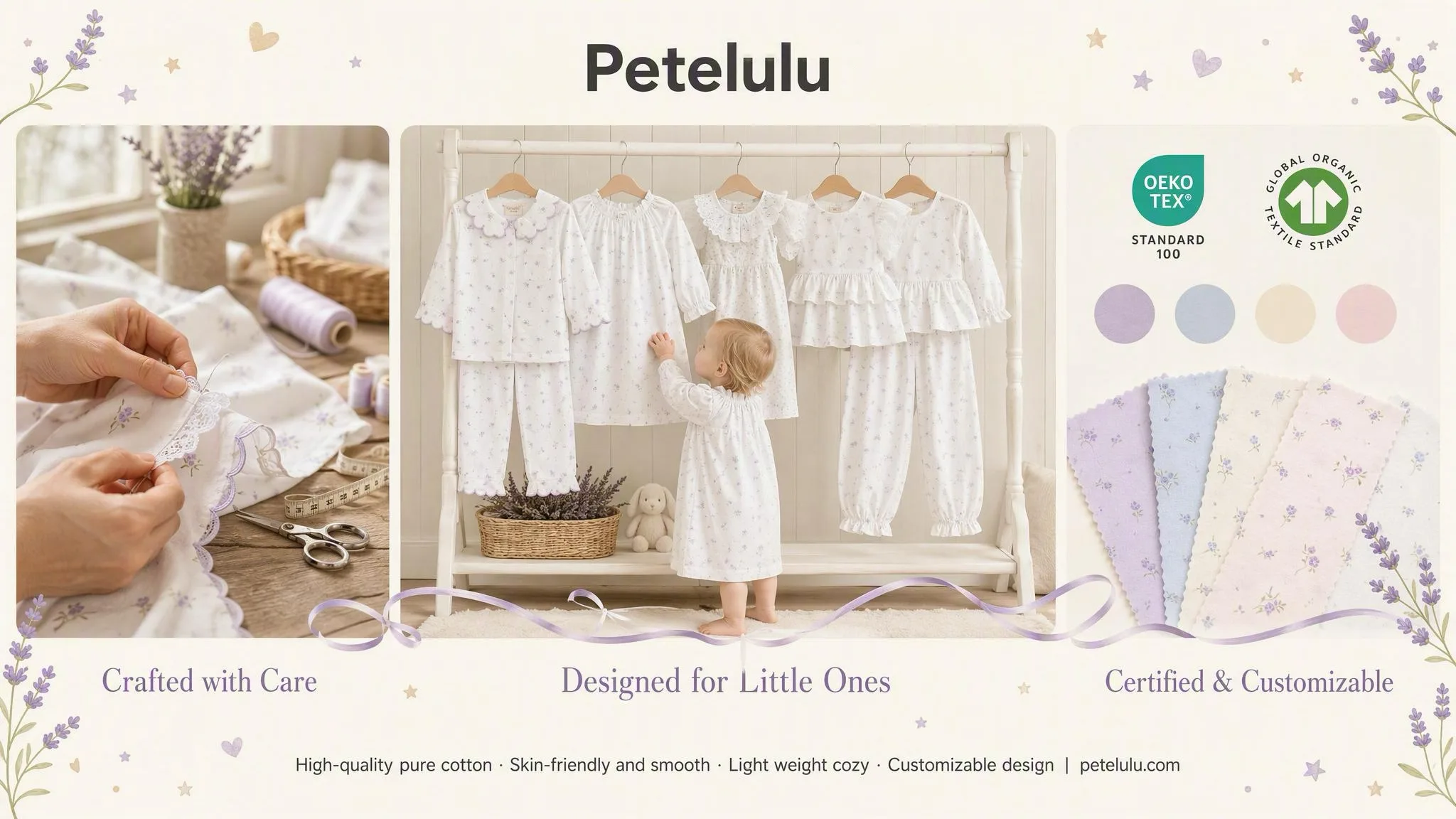
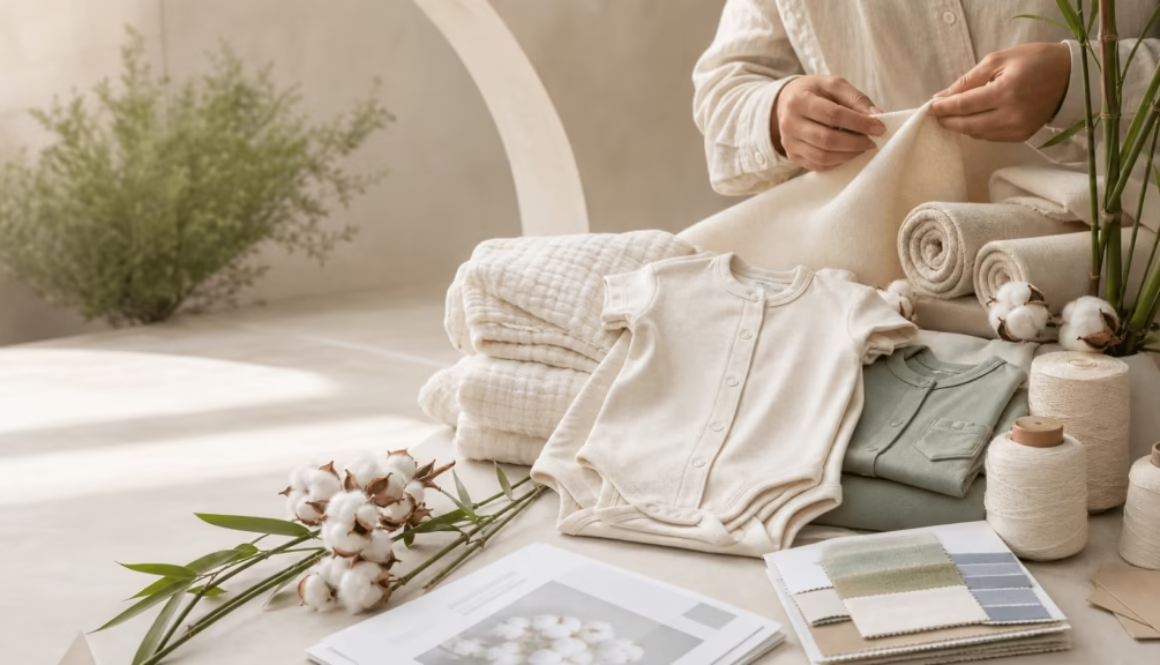
Figure 2 | Reference for check 8: OEKO-TEX Standard 100 and GOTS certification marks alongside the finished garment and fabric range.
Frequently Asked Questions
What is the latest I can place a Ramadan order?
If you need sampling and development from scratch, confirm the order by early November 2026. If you already have an approved sample and are going straight to bulk, late November is the practical limit. Starting a new project in December means running into the Chinese New Year shutdown, and in most cases missing the Ramadan selling window.
What is the minimum order quantity for family pajamas?
200–300 pieces per style per colour, adjusted for fabric and design difficulty. Provided the fabric and construction stay unchanged, the total piece count can be distributed flexibly across sizes.
What size range can a family-matching set cover?
Standard lines run from baby sizes all the way through adult sizes, with the whole set sharing one fabric and one colour code. Dye-lot control is the priority, so that shade variation does not show up in the family photo.
How long do sampling and bulk production take?
Sampling is 7–15 working days. Bulk production is 45–50 working days, measured as the complete cycle from order confirmation to delivery at the buyer’s warehouse, and already includes production, logistics and customs clearance.
Does the quote include duties and customs clearance?
A DDP quote is available, covering destination-country duties and customs clearance with door-to-door delivery, so the buyer does not need to handle import formalities.
Which fabrics can you produce for Ramadan sleepwear?
Pure cotton, bamboo fibre, modal, cotton-linen blends, waffle knit and organic cotton, among others. Development from a customer-supplied fabric card is also possible.
Do you support branding and gift-box packaging?
Yes — OEM and ODM are both supported, with custom logo, hang tags, care labels and gift boxes.
Planning Your 2027 Ramadan and Eid Collection
If you are developing a 2027 Ramadan and Eid range, send your technical pack or a reference sample. You will receive a fabric proposal, a complete size chart with tolerances, and a quotation — along with a project schedule mapped to a February 2027 on-shelf date.
If you are comparing manufacturers, the order calendar separates them faster than any brochure. A supplier who asks for your fabric decision in October is planning your season; one who is still quoting in December is not. The single most useful thing you can do this month is decide the season’s fabric and core colour family, because that decision unlocks sampling. Everything downstream — dye lots, size breakdown, packaging — is cheaper to settle before the November order window than after it.
Two other decisions are worth locking early. First, confirm that every piece in a family set will come from one fabric and one dye lot; if your supplier cannot commit to that in writing, the photograph will expose it. Second, decide your size curve before you approve the order, since baby and adult sizes do not sell in even proportions.
If your schedule is already tight, air freight is the one variable that can absorb a 2–3 week slip, so keep it priced as a contingency rather than discovering the cost late.
Ready to start? Send your specification, target monthly volume and target landed cost. As a family pajamas manufacturer
working to the 2027 Ramadan and Eid calendar, we will confirm the sampling slot, the size breakdown and pricing for your collection.